ALIGNED AI • AI WORKSPACE • 2025
Less time asking. More time living.
Live prototype
 Open live product at joinaligned.ai
- Role
- Product Designer
- Timeline
- 2025 – 2026
- Team
- Aligned AI
- Skills
- AI and agent UX design, Accessibility and trust UX, End-to-end product design
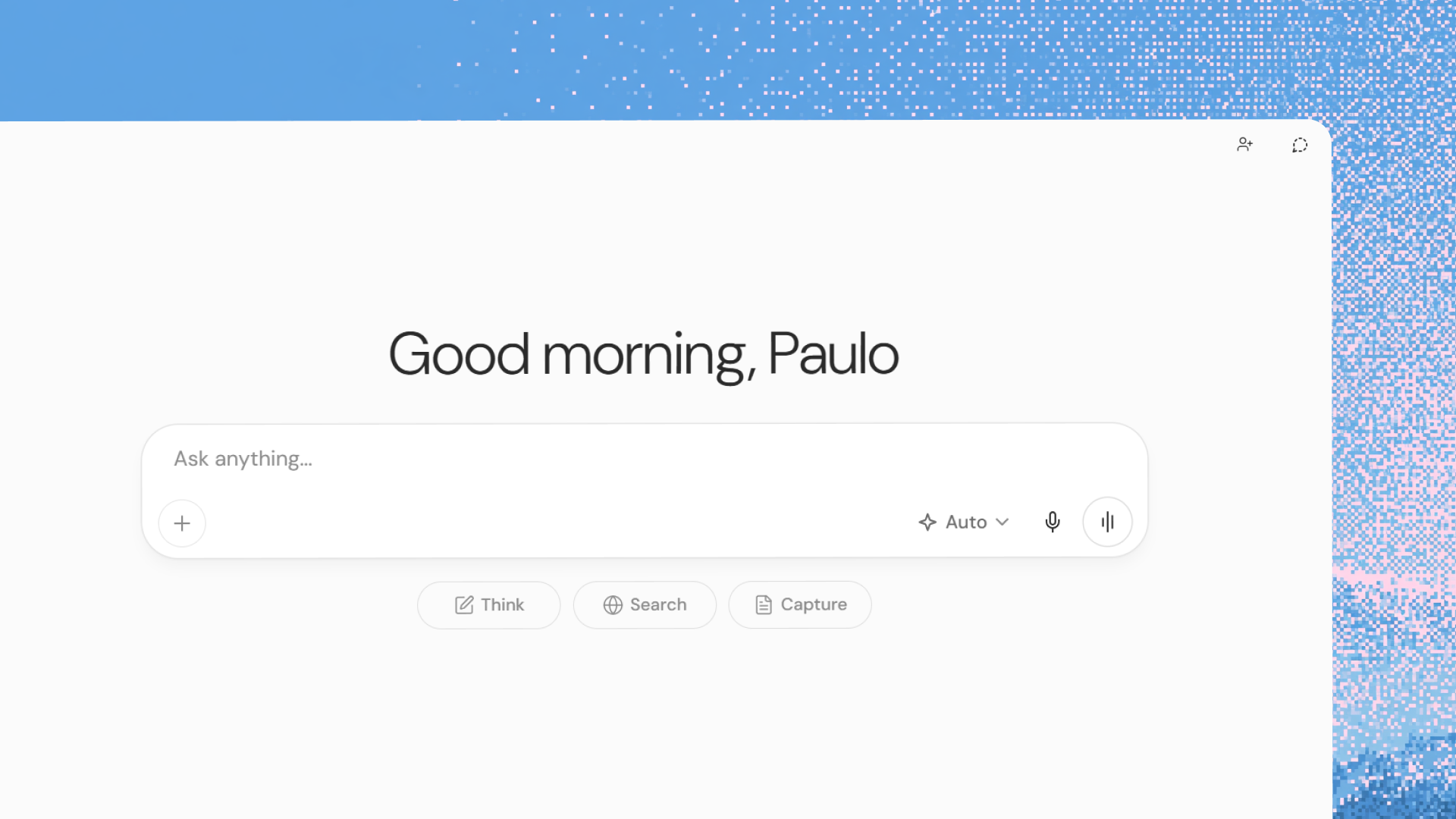
Workspace home
Supporting flows
Mobile
Launch film
Split workspace
Problem
Aligned is building in the personal AI workspace category — a space where generic chat UIs fail because professionals need persistent context, trustworthy outputs, and workflows that fit how they already work.
The design challenge wasn't a landing page. It was making AI feel like a workspace you can rely on: clear ownership of suggestions, readable benchmark content, and surfaces that don't collapse under real data density.
Process
I mapped the core jobs: orient in the workspace, run an AI-assisted task, review output, and commit a result. Each step needed explicit trust UX — not bolted-on disclaimers, but structural clarity in the UI.
Benchmark content was treated as product evidence, not a side project. The structure mirrors how users evaluate AI tools: capability, limits, and comparison points.
I prototyped key flows in code so PM and Eng could react to real interaction — scroll, focus, loading, and error states included.
Outcome
Shipped production UI at joinaligned.ai — workspace home, document review, voice capture, and settings — plus consumer and enterprise landing pages and a launch film used in GTM.
Trust UX patterns (provenance, draft vs. committed, human-in-the-loop) are live in the product, not a slide deck — the team uses them as the baseline for new AI-assisted flows.
What I'd do differently
Instrument earlier usability sessions on the commit/review step — that's where trust breaks or holds, and we relied too much on internal review at first.
My role
Owned
- Product UX for the personal AI workspace concept
- Information architecture for benchmark and docs surfaces
- Visual system and interaction patterns for AI-assisted flows
- Production UI implementation in code
Did not own
- Core AI model training and inference
- Backend infrastructure and auth
- Go-to-market and sales motion
Collaborators: Aligned AI, Engineering partners
Key decisions
Decision 1
Workspace-first vs. docs-first
Chose: Lead with a workspace metaphor — users need a place to work, not another docs site. Benchmark content supports the product story instead of replacing it.
Rejected: A standalone Mintlify docs site with no product shell. It would read like marketing, not something you'd use daily.
Decision 2
Trust patterns for AI output
Chose: Explicit provenance, editable drafts, and clear human-in-the-loop states — so users always know what the system suggested vs. what they committed.
Rejected: Magic auto-complete with no audit trail. Fast to demo, impossible to trust in a professional workflow.
Decision 3
Prototype fidelity
Chose: Ship working UI in code early — enough to test navigation, density, and agent handoffs with real stakeholders.
Rejected: High-fidelity Figma only. The team needed to feel latency, scroll, and state — not a slideshow.